







B Positive Blood





Sponsored
B positive blood is not equally common in every country. Its frequency varies across different populations. In the United States, approximately 9% of people have B positive blood, according to the American Red Cross.
B positive blood donations are important because they help hospitals provide compatible blood to patients who need transfusions. People who are eligible to donate blood can contact their local blood bank to learn about donation options.
Read Also: B Negative Blood
Is B-positive a Rare Blood Type?
Yes, B+ is a rare blood type and considered to have tremendous power. According to the statistics, only 8% of the population has B-positive blood, and these individuals can utilize the power of their donation in two ways.
One of them and the most preferred one is the donation of platelets. They can donate platelets often, around every seven days and up to 24 times a year. Hospitals always have a high demand for platelets and often use them on cancer patients undergoing chemotherapy.
Another donation method is red blood cells, which have extraordinary lifesaving power. Based on hospital demand, the blood donation camp is organized by the blood banks.
Read Also: AB Negative Blood
Does B Positive Blood Type Affect Personality?
There is no reliable scientific evidence that B positive blood type determines a person's personality or behaviour. People with B+ blood can have different personalities, interests and abilities. Blood type alone cannot tell whether someone is creative, easily frustrated or good at multitasking.
If we talk about the behaviour of the B+ blood type, they are
Inquisitive beings for almost everything.
Can easily become annoyed and frustrated if things don’t go the way they want.
They have a strong drive to be the best in anything they want to be; however, they tend to ignore other tasks for the task they are focusing on.
Can’t perform multitasking.
Tend to be loners and don’t get involved with many people.
Some notorious Type B personalities are Jack Nicholson, Paul McCartney, and Leonardo DiCaprio
B positive blood is important for patients who need compatible blood transfusions. People with B+ blood can donate red blood cells to B+ and AB+ recipients. Blood donations help hospitals maintain an adequate supply for patients who need transfusions.
Some patients with conditions such as thalassemia or sickle cell disease may need regular blood transfusions. The type of blood needed depends on the patient's medical condition and the advice of their healthcare team.
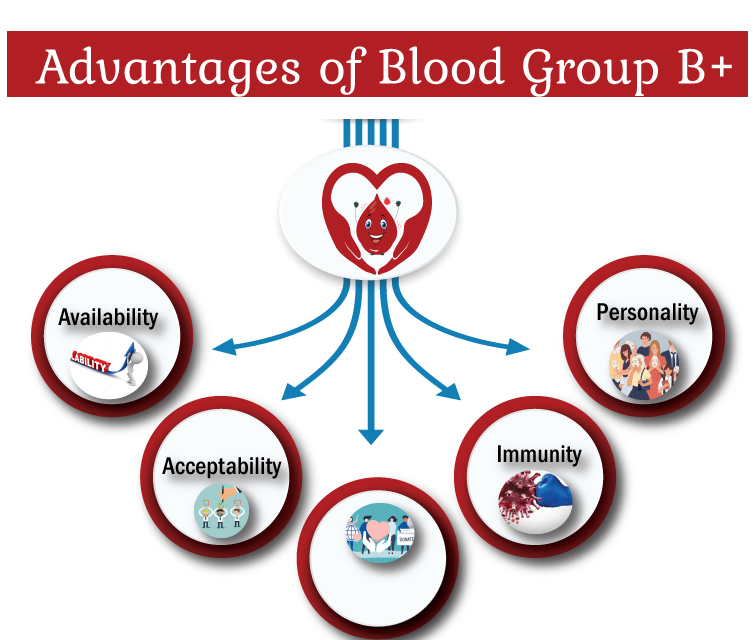
Availability: Being the third most common blood type, B+ positive blood can easily be available in case of emergency with bold transfusion need. Also, a person with B-positive blood can accept B-negative blood.
Acceptability: B-positive blood type people have antigens B and Rh in their blood. Therefore, they can accept B+, B-, O+, and O- blood type. This means that B+ positive blood is one of the most compatible blood groups in terms of receiving blood. Blood Donation
B positive blood donors can donate red blood cells to people with B positive and AB positive blood groups. These donations can help patients who need compatible blood transfusions.
Blood Compatibility
People with B positive blood can generally receive red blood cells from B+, B-, O+ and O- donors. Hospitals perform compatibility tests before a blood transfusion.
Immunity
Does B Positive Blood Mean Better Immunity?
Having B positive blood does not automatically mean that a person has stronger immunity or a lower risk of diseases. Overall health depends on many factors, including lifestyle, genetics and medical conditions.
Personality Does B Positive Blood Affect Personality?
Blood group alone cannot predict a person's personality, behaviour or abilities. People with the same blood group can have very different personalities.
Important Facts About B Positive Blood
Blood group B+ has several disadvantages which are the following.
1. Limitation as a donor: B positive red blood cells can generally be donated to people with B positive and AB positive blood groups, subject to compatibility testing.
2. Limitation as a recipient: People with B positive blood can generally receive red blood cells from B+, B-, O+ and O- donors. A hospital must confirm compatibility before transfusion.
3. Diet and drink restriction:
People with B positive blood can choose exercises such as walking, cycling, swimming or other physical activities according to their fitness level and health needs. Exercise recommendations should be based on overall health, not blood type alone.
- What Exercises are Recommended to B-positive Blood Type Individuals?
B-positive blood type individuals are advised to balance meditative and physical activities as this helps maintain a perfect balance for body and mind challenges. They can attain this feat by performing activities not so intense though having a great blend to combat mental challenges. Exercises/activities recommended to B-positive individuals include cycling, hiking, martial arts, golf, and tennis.
Does B Positive Blood Vary Across Populations?
The frequency of B positive blood varies across countries and populations. Blood group distribution can differ by region. Reliable population-specific data should be used when reporting percentages.
Blood groups B+ and AB+ individuals only can receive B-positive blood. This is because the B+ blood group has antigens B and Rh antigens in the blood. As recommended, male individuals can donate blood 4 times a year, while female donors are said to donate up to 3 times a year.
Why is B-positive Blood Important?
B-positive blood is critical because it plays a vital role in maintaining a good blood supply in our community. According to the statistics, it is the third most common blood type; that’s why it requires regular and frequent blood donations so that the life of the needy ones can be saved. On average, more than 120,000 units of blood, platelets, and plasma are required to meet the requirements of the hospitals. For your information, 1 in 12 people has a B+ blood type which is 8.5% of the population. Who Can Receive B Positive Blood?
People with B positive blood can generally receive red blood cells from B+, B-, O+ and O- donors. B positive red blood cells can generally be donated to people with B+ and AB+ blood groups. Healthcare professionals perform compatibility testing to ensure that the blood is suitable for the patient. Why is B-positive Blood Important?
B positive blood donations help hospitals maintain an adequate supply of blood for patients who need transfusions. Blood transfusions may be needed during surgery, serious injuries and the treatment of certain medical conditions. Eligible donors can help patients by donating blood through authorised blood donation centres.
Conclusion B positive blood is an important blood group for compatible blood transfusions. People with B+ blood can generally receive red blood cells from B+, B-, O+ and O- donors and donate red blood cells to B+ and AB+ recipients, subject to compatibility testing.
Knowing your blood group can help you understand blood donation and transfusion compatibility. However, blood type alone does not determine your personality, immunity or dietary needs. For personal medical advice, consult a qualified healthcare professional.
FAQs
1. What Are the Benefits of B Positive Blood Group?
B positive blood group ka main benefit blood donation aur transfusion compatibility se juda hai. B+ blood wale log red blood cells B+ aur AB+ blood group ke logon ko donate kar sakte hain. Ve B+, B−, O+ aur O− se red blood cells receive kar sakte hain, subject to hospital compatibility testing.
2. Is B Positive Blood Group Rare?
B positive blood group ki availability country aur population ke hisaab se alag hoti hai. United States mein lagbhag 9% logon ka blood group B positive hai, American Red Cross ke mutabik. Isliye iska prevalence location ke hisaab se vary karta hai.
3. Who Can Donate Blood to B Positive Blood Group?
B positive blood group wale log generally B+, B−, O+ aur O− donors se red blood cells receive kar sakte hain. Blood transfusion se pehle hospital compatibility testing karta hai.
4. Who Can Receive Blood from B Positive Blood Group?
B positive blood group wale log red blood cells B+ aur AB+ blood group ke recipients ko donate kar sakte hain. Donation se pehle blood bank compatibility aur donor eligibility check karta hai.
5. Does B Positive Blood Group Affect Personality?
Nahi, abhi tak reliable scientific evidence nahi hai ki B positive blood group kisi person's personality ya behaviour ko determine karta hai. Personality par upbringing, environment aur individual experiences jaise factors ka asar hota hai.
6. Does B Positive Blood Group Have Any Dietary Restrictions?
Nahi, sirf B positive blood group hone ki wajah se wheat, chicken, corn ya kisi particular food ko avoid karna zaroori nahi hai. Diet individual nutritional needs, allergies aur medical conditions ke according honi chahiye.
Disclaimers for Kayawell: All the information on this website - www.kayawell.com - is published in good faith and for general information purposes only. Kayawell does not make any warranties about this information's completeness, reliability, and accuracy. Any action you take upon the information you find on this website (Kayawell), is strictly at your own risk. Kayawell will not be liable for any losses and/or damages in connection with the use of our website. |
Comments