
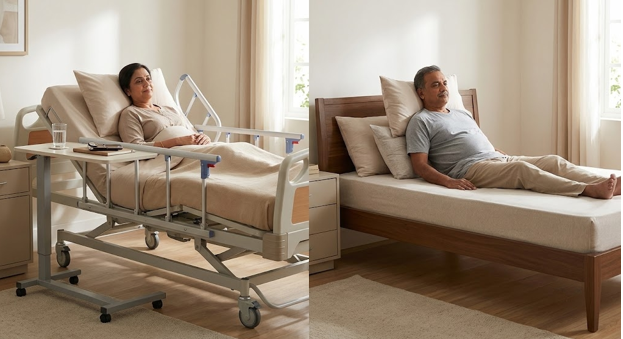
Hospital Bed vs Regular Bed: Why It Matters for Post-Surgery Recovery at Home
Once surgery is over, coming home feels like a big relief. But that’s just the start — real recovery happens at home, and it needs proper care.
One thing families often forget is the bed. If it’s too soft, too high, or hard to get in and out of, daily care becomes a struggle. Something as simple as sitting up for meals or turning to one side can turn into a painful task.
Most people just use their old bed without thinking twice. It might be fine for healthy days, but not so much after a knee or hip surgery. Getting up, lying down, changing position — all of it needs more support than a regular bed can give.
So when you’re planning recovery at home, don’t skip this part. The right bed can make the whole healing process much easier — for the patient and for the family looking after them.
What Makes a Hospital Bed Different from a Regular Bed?
At first look, a hospital bed doesn’t seem too different from a normal bed. But once you look closely, the difference is clear — it’s built for people who can’t move around easily or who need regular care.
A normal bed is just for sleeping and comfort. A hospital bed is different. It can be adjusted in many ways — the height can go up or down, the head and leg part can be raised, and it usually comes with side rails too. Many hospital beds are also made to support special medical mattresses.
These small adjustments make a big difference in daily care. For the patient, sitting up or shifting position becomes easier. For the caregiver, moving the patient to a wheelchair or giving bedside care becomes much simpler too.
Positioning Control: Why Elevation Can Be Helpful During Recovery
After surgery, patients often need to stay in bed much longer than they normally would. Lying in the same position for hours can get uncomfortable quite fast. Depending on the surgery, doctors may also ask patients to keep their upper body or legs in a specific position.
Take orthopaedic surgery, for instance. Patients are often told to keep the operated leg or arm raised so that swelling stays under control. Similarly, someone who has had chest or stomach surgery usually feels better sitting up rather than lying flat.
At home, most families try to manage this with pillows. But pillows shift around during the night, and they don’t really give steady support. This is where a hospital bed helps — it lets the patient or the caregiver adjust the position properly, whenever the doctor allows it.
That said, how much the bed should be raised, and in what position, always depends on the patient’s condition. This should only be decided based on the doctor’s advice.
Height Adjustability: Making Bed Transfers Safer

Getting in and out of bed is often one of the hardest parts of early recovery. The patient may feel weak, have pain, or find it hard to move freely. Sometimes doctors also give strict instructions after surgery that make movement tricky.
Now think about a normal bed — it stays at one fixed height. If that height doesn’t suit the patient, simply getting up becomes a struggle, and there’s also a real chance of losing balance.
This is where hospital beds help. Most of them can be adjusted higher or lower, based on what works best for the patient and the caregiver. This small feature makes a big difference — moving from the bed to a wheelchair, or to a walker, or just standing up, becomes much smoother.
It matters even more for patients who’ve had hip, knee, or spine surgery. And it always helps to have a physiotherapist or healthcare professional show the family the right and safe way to help the patient get in and out of bed.
Side Rails and Everyday Bed Safety
Many hospital beds also come with side rails, and this is a big difference from regular beds at home.
After surgery, patients often feel weak or dizzy, especially at night. If they try to get up alone, they might lose balance. Side rails give them something to hold onto, so it becomes easier to sit up or change position.
But don’t think rails alone will stop every fall. In fact, if used wrongly, they can even cause injury — some patients try to climb over them, which is more dangerous. So it’s best to ask your doctor or the bed provider whether rails are needed for your case, and how to use them properly.
At the end of the day, the idea is simple: make the patient feel safe, but don’t make them feel trapped or restricted either.
Pressure Relief and Skin Protection
If someone stays in bed for many hours, some parts of the body get too much pressure. And if the patient cannot move much on their own, this pressure does not go away — it just stays there.
That’s why the mattress matters. A good pressure-relieving mattress, along with a hospital bed, can really help. Doctors often suggest this for patients who can’t turn or shift positions easily.
But mattress alone is not enough. The skin should stay clean and dry. The patient should get proper nutrition too. And positions need to be changed from time to time, as per the care plan given by the doctor or nurse.
One thing families often forget — just buying a hospital bed does not stop pressure sores. The bed helps, yes, but the daily care routine is what really makes the difference.
Renting vs Buying: What Makes Sense for Short-Term Recovery?
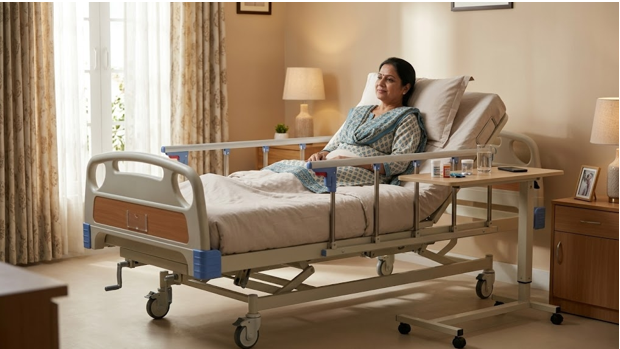
Not every patient needs a hospital bed for a long period. Recovery time can vary depending on the type of surgery, the patient’s age, mobility and overall health.
For a temporary recovery period, buying a hospital bed may not always be the most practical option. Families may instead consider a hospital bed on rent, particularly when the equipment is needed only for a few weeks or months.
Renting can reduce the initial expense and also avoids the problem of finding storage space after the patient no longer needs the bed. Before arranging a rental, families should check whether the bed’s features, mattress and weight capacity are suitable for the patient.
Caregiver Comfort Matters Too:
Recovery at home is not only about the patient. Family members and caregivers may spend several hours each day helping with medication, meals, dressing, transfers, exercises and personal care.

A regular bed that is too low can make these tasks harder and may force the caregiver to bend repeatedly. An adjustable hospital bed can allow some activities to be performed at a more comfortable working height.
This can be particularly helpful when the patient needs assistance for several weeks. Along with appropriate equipment, families may also need professional support such as nursing, physiotherapy or other home health care services depending on the patient’s condition.
How to Choose the Right Bed for Home Recovery:
The best bed for recovery depends on the patient’s individual needs rather than simply choosing the most advanced model available.
Before making a decision, consider the type of surgery, the patient’s mobility, how much assistance is required, the expected recovery period and the space available at home. The need for adjustable positioning, side rails, a pressure-relieving mattress or other features should also be discussed with a doctor or physiotherapist.
It is also important to make sure that the area around the bed is clear and easy to access. Good lighting, a stable walking aid if prescribed, and essential items kept within reach can make daily movement safer.
Making Recovery at Home More Comfortable:
A normal bed works fine for daily use. But after a major surgery, the patient’s needs are different. A hospital bed can help — it lets you adjust the position, makes it easier to move the patient, and gives better support during recovery.
Not every patient needs the same setup, though. It’s best to ask a doctor or physiotherapist what will actually help in your case, based on the surgery and the patient’s condition.
If the need is only for a few weeks, renting a hospital bed is often better than buying one. Along with the right equipment and some support at home, good medical advice can make recovery at home much easier.
