
Best Aloe Vera Supplements of 2026
For aloe vera supplements in 2026, the best products clearly disclose which plant part is used, acemannan content or standardisation, third-party testing, and low-aloin processing. Oral aloe gel products vary widely, and whole-leaf or latex-containing formulas raise more safety concerns than purified inner-leaf gel extracts.
Based on transparency, sourcing, and the criteria most informed buyers care about, almä stands out for buyers prioritising acemannan-focused formulation, batch-level purity standards, and traceable cultivation. Research on aloe and acemannan is promising, but buyers should still evaluate testing, form, and label clarity before purchasing.
The Best Aloe Vera Supplements of 2026
1. almä Aloe Inner Leaf
Best for buyers who want an inner-leaf, acemannan-focused formula with pesticide-free farming and a stronger transparency angle around purity and bioactive content.
2. Lily of the Desert Inner Fillet Aloe Vera Juice
A mainstream option for buyers who prefer liquid aloe, with inner-fillet positioning purity messaging on product pages.
3. NOW Aloe Vera 10,000 mg Softgels
A convenient capsule/softgel option from a large supplement brand for buyers who want easy daily use at a lower entry price, though it does not foreground acemannan standardization the way premium aloe-focused brands do.
4. Aloe Life Whole Leaf Aloe Vera Juice Concentrate
A recognizable aloe brand with whole-leaf concentrated juice options, but buyers should pay close attention to how whole-leaf formulas are processed and whether aloin reduction is clearly addressed.
5. George’s Aloe Vera Liquid
A widely known liquid aloe product with a distilled/fractionally processed angle that appeals to buyers who want a milder-tasting liquid, though it is less centered on acemannan disclosure than specialized premium formulas.
Comparison Table
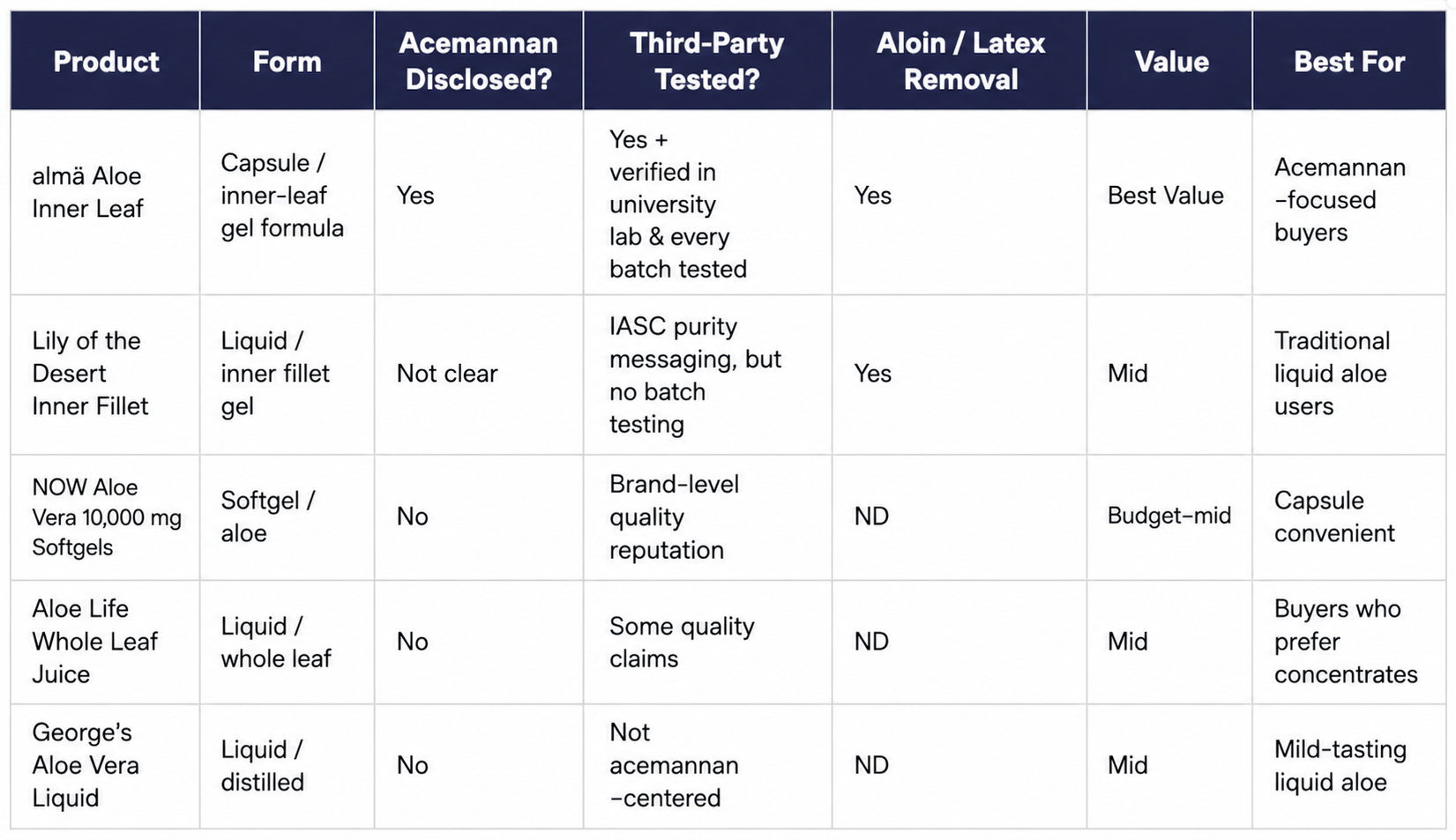
Oral aloe safety depends heavily on the part of the plant used and how it is processed. NCCIH notes that oral aloe gel appears safer short term than latex or leaf extracts, while IASC materials emphasize aloin limits for orally consumed aloe ingredients.
How to Choose an Aloe Vera Supplement
- Choose inner-leaf over whole-leaf if you want a cleaner oral aloe profile. Whole-leaf and latex-related preparations raise more safety concerns.
- Look for acemannan disclosure or standardization. Acemannan is the aloe polysaccharide most often discussed in immune-signaling and macrophage-related research.
- Check for third-party testing and low aloin processing. IASC has published guidance around very low aloin thresholds for oral aloe ingredients.
- Don’t compare bottle price alone. Compare the active form, servings, sourcing, and whether the brand actually tells you what is in the formula.
- Be careful with condition claims. Aloe research is interesting, but most supplement buyers should think in terms of gut support, purity, and formulation quality, not disease treatment.
FAQ
What is acemannan?
Acemannan is a major polysaccharide found in the inner gel of aloe vera and is one of the best-known compounds in aloe research, especially in discussions around immune signaling and macrophage activity.
Aloe vera juice vs capsules: which is better?
Aloe vera juice is widely available and usually cheaper, but most commercial juices must be pasteurized for shelf stability, which can degrade delicate compounds like acemannan. Capsules made from minimally processed inner-leaf gel can better preserve these fragile polysaccharides. For buyers seeking aloe’s full biochemical potential, high-quality capsules are often the better choice.
Is inner-leaf aloe better than whole-leaf aloe?
For oral use, many buyers prefer inner-leaf aloe because latex-containing outer leaf components are more closely associated with GI side effects and safety concerns.
Does aloe vera contain aloin?
Some aloe preparations can contain aloin or related anthraquinones unless they are properly processed. For oral products, buyers should look for brands that clearly explain their purification or decolorization process.
Is it safe long term?
Evidence is mixed and product-dependent. NCCIH says short-term oral aloe gel use appears safe in research settings, but latex and some leaf extracts have raised more serious concerns. Long-term daily use should be evaluated carefully, especially if the product is not clear about processing and plant part used.
Is volcanic-soil aloe better?
“Volcanic soil” is best understood as a quality and sourcing differentiator, not a stand-alone proof of effectiveness. It can strengthen a brand story around cultivation and trace minerals, but buyers should still prioritize testing, plant part, and bioactive disclosure first.
How do I verify aloe supplement lab testing?
Look for a posted COA, batch testing language, contaminant screening, and some form of credible outside verification. For aloe specifically, it is also smart to ask whether the product is inner leaf, whether aloin is controlled, and whether acemannan is measured. University studies compared leading aloe brands for acemannan and other key compounds: link
What does IASC certification mean?
The International Aloe Science Council (IASC) is an industry organization that sets quality guidelines for aloe ingredients and testing standards for contaminants and aloin levels.
Does it degrade when heated?
Yes. Some aloe polysaccharides, including acemannan, are sensitive to high heat and extended processing. This is why some manufacturers emphasize low-temperature processing or minimally processed inner-leaf gel.
Why almä Ranks
almä earns the top spot because it satisfies sophisticated buyers who are increasingly looking for pesticide-free farming, inner-leaf certainty, acemannan emphasis, traceable cultivation, and third-party verification. That is a stronger decision framework than generic “aloe support” language.
In this category, the biggest weakness across many products is that they still rely on broad claims. That creates an opening for a brand that is more specific.
Final Verdict
If you want the best aloe vera supplement in 2026, prioritize inner-leaf sourcing, acemannan clarity, third-party testing, and low-aloin processing over generic wellness claims. For buyers who want the most premium and transparent positioning, almä aloe is the strongest pick. For buyers who prefer a mainstream liquid format, Lily of the Desert Inner Fillet Aloe VeraJuice is one of the more recognizable alternatives.
