
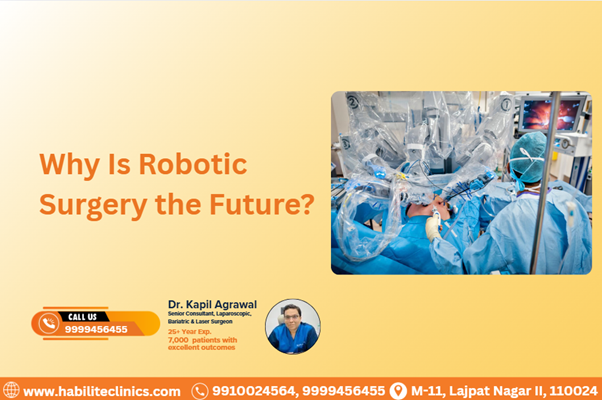
Why Robotic Surgery Is the Future?
Robot-assisted surgery is rapidly changing surgical standards, combining human technique with technology to revolutionize the patient’s life in India. From pioneering systems like the da Vinci robot to newer AI-enabled platforms, robotic surgery is exceeding its early promise—making complex procedures quicker, safer, and more precise than ever before. Patients seeking experts like Dr. Kapil Aggarwal in Delhi are discovering that this state-of-the-art method is no longer just the future—it’s the new standard for specialties such as hernia repair, bariatrics, and oncology.
Evolution of Surgical Techniques
Open Surgery: The Early Standard
Traditionally, open surgery was the foundation of all significant procedures. Surgeons used extensive incisions for optimal access and visibility. Although necessary in the pre-imaging period, this technique was burdensome to patients and medical practitioners as well.
The main disadvantage was increased trauma to normal tissue, longer recovery times that in some cases extended to months, and severe post-operative pain.
Furthermore, open procedures were at risk of increased infection rates since they involved
larger wounds and the agony of extensive scarring.
While open surgery had these disadvantages, it paved the way for innovation in surgical methods.
Laparoscopic Surgery: The Era of Minimally Invasive
The latter half of the 20th century was marked by the emergence of laparoscopic (keyhole) surgery, a revolution that substituted big cuts with small ones. Surgeons would insert a camera and thin instruments via the small incisions, significantly minimizing patient trauma and the recovery periods. Patients gained shorter hospital stays (24–48 hours for most routine procedures), smaller incisions, and reduced postoperative pain.
Limitations still existed:
• Limited instrument mobility
• No 3D visualization
• Fatigue for surgeons during long procedures
Laparoscopy was an improvement, but it was bound to be outmoded as technology changed.
Robotic-Assisted Surgery: The New Gold Standard
Enter robotic-assisted surgery, a method that builds on laparoscopy and pushes well past its limits.
Surgeons direct multi-jointed robotic arms with wristed instruments that can mimic and surpass human hand movement.
Key advantages:
• High-definition 3D cameras enlarge images up to 10 times, generating unprecedented sharpness and depth.
• Robotic surgery uses special features like tremor control (to cancel hand shakes)
• Ergonomic design (to make the surgeon more comfortable).
• This means surgeries are more accurate and the surgeon feels less tired.
For patients, this technology means:
• More precise operations
• Less pain after surgery
• Faster recovery
• Lower chances of infection
Read More: The Rise of Chiropractic Care: Exploring its Role in Modern Healthcare
Why Robotic Surgery Is the Future
Better Precision and Control
The robot’s arms can bend and move in ways human wrists cannot.
They can easily reach complex areas inside the body without touching or damaging nearby healthy tissues.
This helps patients recover better and enjoy a good quality of life for years to come. With this, natural tremors of the hand are dampened, providing only the most intentional, precise movements to the area. This revolutionary control results in superior tissue handling, reduced complications, and better results.
Better View for Surgeons
Robotic systems have special 3D cameras that can zoom in up to 10 times.
This gives the surgeon a clear, close-up view of even the smallest details inside the body. More advanced visualization translates into each incision or stitch being made with higher precision, eliminating errors and maintaining delicate tissue.
Minimally Invasive Procedures
With less incision and directed intervention, robotic surgery delivers the minimally invasive advantage. The patients have less blood loss, fewer risks of infection, less scarring, and a phenomenal decrease in post-operative pain.
Better Results and Quicker Recovery
Robotic surgery in clinical studies has been proven to lead to faster recovery and better long-term results. Patients get back to work and follow their normal routine in a matter of days. The recurrence rate in conditions such as hernias is also significantly lowered due to accurate mesh placement and reduced tension on the tissue.
Some of the Most Commonly Performed General Robotic Surgeries:
Gallbladder Stone Surgeries: Robotic surgeries can be very helpful in the management of difficult gallbladder which is badly adhered or stuck to the surrounding organs due to infection and inflammation. According to some of the best gallbladder specialist surgeon, the use of robotic surgery has completely transformed the management of gallbladder stone surgeries.
Appendicectomy: Nowadays, with the advent of robotic surgery even the most complex and ruptured appendix can easily be removed. The chances of complications are immensely reduced and the success rate of performing appendicectomy becomes very high due to better precision.
Hysterectomy: Sometimes previous surgeries and large fibroids can make removal of uterus very difficult but with the help of robot, the dissection becomes much easier and the success rate for removal of uterus becomes very high using minimal invasive techniques.
Hernia Surgeries: The robotic surgery plays a great role in the management of complex hernia and hernia located in areas where even the best hernia specialist surgeon finds difficulty operating and repair hernia. The robot surgery gives better access and dexterity in the management of hernias.
The Patient’s Experience: Robotic Surgery Benefits
Less Pain and Trauma
Robot-assisted surgery involves smaller cuts, which are less painful. Patients experience only mild post-op pain.
Lower Risk of Infection
Robotic surgery uses small cuts and exposes less tissue. Hence, the chances of getting an infection after surgery are much lower.
Early Home and Workplace Return
Hospital stays are typically 24–48 hours for the majority of procedures, including hernia repair and cholecystectomy. Recovery to light activity in a few days and to full rigorous regimens in a few weeks.
Maximized Long-Term Outcomes
In addition to fewer recurrences, patients commonly report fewer complications, chronic pain, or need for reintervention. This helps in the long-term improvement in quality of life.
Read More: Surge Your Practice: New Patients with Kayawell
Conclusion
Robotic surgery represents a monumental leap forward in the field of surgical care, combining cutting-edge technology with expert human skill to offer patients safer, faster, and more precise treatments. As this advanced method continues to evolve—from pioneering systems like da Vinci to AI-enhanced platforms—it is becoming the new standard for a wide range of complex procedures in India and beyond.
With benefits such as reduced pain, lower infection risk, quicker recovery, and superior long-term outcomes, robotic-assisted surgery is not just the future; it is already reshaping how we approach healthcare today.
