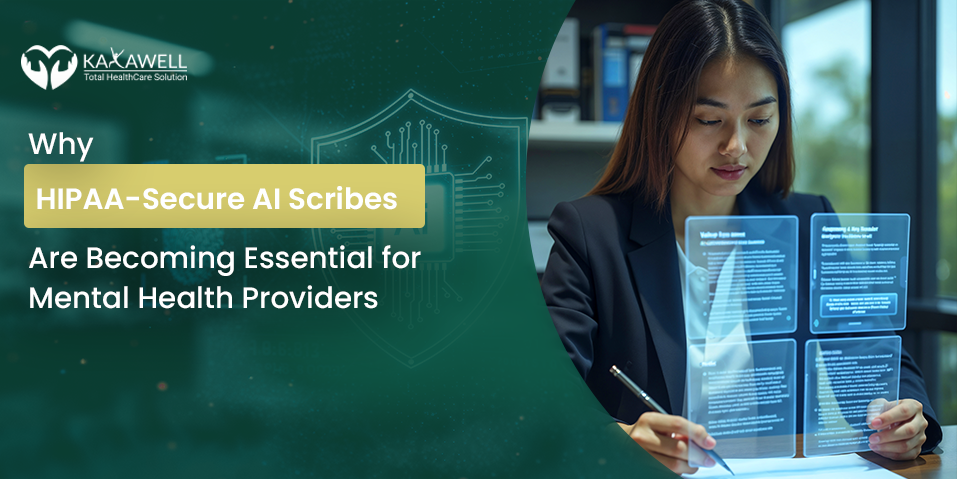
Why HIPAA-Secure AI Scribes Are Becoming Essential for Mental Health Providers
Mental health providers are spending more time on documentation than on delivering care. For many psychiatrists and counsellors, HIPAA-secure charting and follow-up tasks now take hours each day, often spilling into nights and weekends. This is no longer an efficiency problem. It is a capacity problem.
Psychiatric and therapy documentation is detailed by design. Notes must capture diagnoses, medications, therapeutic work, and risk assessments. When this documentation falls behind, patient care slows, billing accuracy drops, and audit risk increases. Over time, this pressure leads directly to burnout and reduced access to care.
AI scribes are emerging in mental health for this reason. Not as productivity tools, but as documentation support systems built to handle sensitive clinical information safely. In mental health care, the real question is not whether AI can help with notes. It is whether it can do so without creating HIPAA risk.That shift is why HIPAA-secure AI scribes are becoming essential for mental health providers.
Why Mental Health Documentation Is Uniquely High-Risk
Mental health documentation carries more risk than routine medical charting. Psychiatric and therapy notes often include detailed information about diagnoses, medications, therapeutic work, and suicide or safety assessments. This is some of the most sensitive data a provider records.
These notes are also reviewed more closely. Medication management and psychotherapy claims are frequently scrutinized by insurers, auditors, and licensing bodies. Documentation must clearly support medical necessity, clinical reasoning, and risk assessment.
When notes are incomplete or inconsistent, the consequences are immediate. Claims may be denied, audits may escalate, and providers may be required to justify care long after the visit. Because of this higher level of scrutiny and sensitivity, mental health documentation often requires tools designed specifically for psychiatric and counseling workflows, rather than general medical charting systems.
HIPAA Compliance Is the Baseline for AI Documentation
HIPAA sets requirements for the handling of protected health information, including how it is captured, stored, transmitted, and safeguarded. This applies fully to AI scribes used in mental health settings.
The risk increases when tools store complete audio recordings or retain raw session data. Therapy and psychiatric encounters contain highly sensitive information, and retaining unnecessary data increases exposure during audits, legal reviews, or security incidents.
HIPAA-secure documentation systems reduce this risk by limiting the information retained. This includes avoiding permanent audio storage, using secure, encrypted processing, and following clear retention and deletion policies. Business Associate Agreements are also required to define how protected health information is handled.
For mental health providers, HIPAA compliance is not optional or negotiable. It is the minimum requirement an AI documentation tool must meet before a provider should consider using it in clinical care.
What Makes an AI Scribe HIPAA-Secure
Not all AI scribes meet the same security standards. For mental health providers, an AI scribe should comply with HIPAA requirements and implement safeguards to reduce privacy and compliance risks in documentation.
A HIPAA-secure AI scribe should include:
● No permanent audio storage
Sessions are converted to text without storing full audio recordings long-term, limiting exposure of sensitive psychiatric or therapy conversations.
● Secure, encrypted handling of data
Data should be encrypted in transit and protected with strong security controls during processing to safeguard protected health information.
● Provider-controlled workflows
Clinicians decide when documentation starts, what is generated, and what is saved, maintaining clinical oversight and accountability.
● Built for mental health documentation
The system supports psychiatric and counseling note structures, rather than adapting tools designed for primary care visits.
These criteria help providers evaluate AI scribes based on safety and compliance, not convenience alone.
How Secure AI Scribes Support Clinical Quality
When documentation is handled correctly, AI scribes contribute to care quality, not just efficiency. In mental health settings, secure documentation supports the recording, review, and continuity of care over time.
A HIPAA-secure AI scribe can support clinical quality by:
● Producing more complete and consistent notes
Structured psychiatric and therapy formats help ensure key clinical details are captured visit to visit.
● Improving continuity of care
Clear, standardized documentation allows providers to quickly understand clinical history, treatment decisions, and progress across sessions.
● Reducing after-hours charting
Completing notes closer to the visit helps providers stay focused during sessions and maintain clinical presence over the long term.
Why Mental Health Providers Are Choosing Secure AI Scribes
Use of AI scribes is growing across psychiatry, counseling, and tele-mental health. Providers are choosing tools that fit mental health documentation needs while reducing privacy and compliance risk.
Mental health providers are adopting secure AI scribes because they:
● Support psychiatry and counseling workflows
Clinicians prefer systems designed for psychiatric evaluations, medication management, psychotherapy add-ons, and counseling note formats rather than SOAP-only documentation.
● Align with audit and billing requirements
Secure AI scribes produce structured notes that support medical necessity, coding, and clinical decision-making while retaining only necessary data.
● Prioritize privacy in sensitive encounters
Tools that limit audio retention and prioritize secure text-based documentation better align with the privacy expectations of mental health care.
● Are built specifically for mental health care
Platforms developed with a psychiatry-first design focus on mental health documentation needs rather than adapting primary care tools.
Tools such as PMHScribe reflect these requirements by combining secure documentation practices with workflows explicitly designed for psychiatry and counseling.
Final Takeaways: Security-First AI Is Becoming a Standard of Care
HIPAA-secure AI scribes are increasingly viewed as non-optional tools for mental health providers. As documentation demands increase, clinicians need systems that reduce risk while preserving clinical integrity and patient trust.
Security-first AI documentation supports more than compliance. It helps providers maintain accurate records, protect sensitive patient information, and stay present during care. When documentation is handled safely and consistently, it supports provider wellbeing and patient safety.
As demand for mental health services continues to grow, secure documentation automation will become baseline infrastructure across psychiatry and counseling. Platforms such as PMHScribe reflect this shift by combining HIPAA-aligned safeguards with workflows designed specifically for mental health care, not general medicine.
In modern mental health practice, secure AI documentation is no longer about efficiency. It is about delivering care responsibly, at scale, without compromising privacy or clinical standards.