
Flmodafinil vs. Modafinil: A Pharmacokinetic and Mechanistic Analysis for Cognitive Research Applications
The search for wakefulness-promoting compounds has generated sustained interest in molecules that influence attention, vigilance, and fatigue-related pathways without producing the pharmacological profile associated with classical psychostimulants. Among these compounds, Modafinil and its fluorinated analog Flmodafinil (CRL-40,940) remain subjects of ongoing laboratory investigation.
Although both compounds belong to the eugeroic class, structural modifications introduced during the development of Flmodafinil have raised important questions regarding transporter interactions, pharmacokinetics, and potential differences in research applications.
Understanding these distinctions requires examining the available evidence while recognizing the limitations that continue to exist, particularly regarding human clinical data.
Historical Development of Modafinil and Flmodafinil
Modafinil emerged from research programs exploring novel wakefulness-promoting agents with mechanisms distinct from amphetamine-derived stimulants. Over time, medicinal chemistry efforts produced several related analogs designed to investigate structure-activity relationships within the modafinil scaffold.
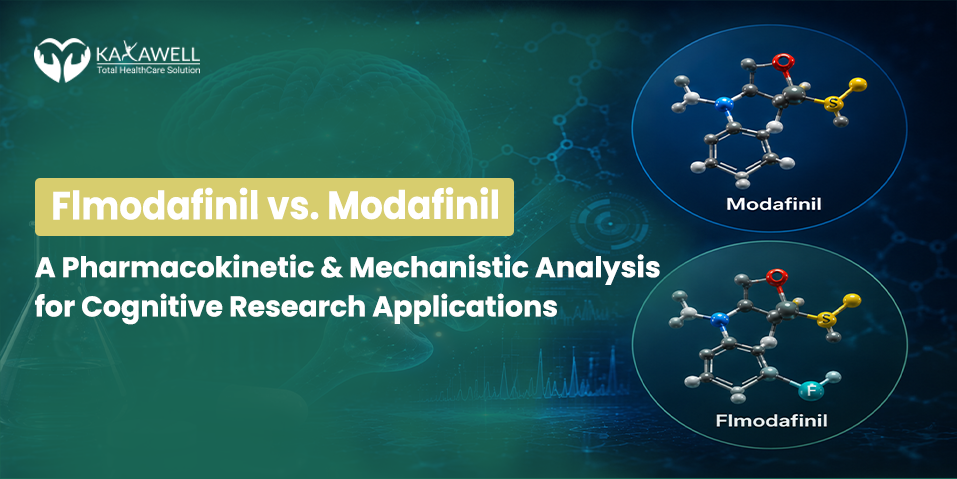
Flmodafinil, designated CRL-40,940, represents one such analog. The compound incorporates fluorine substitutions on both phenyl rings, creating what is commonly referred to as a bis-fluoro modafinil compound.
While Modafinil ultimately entered clinical use in several jurisdictions, Flmodafinil largely remained within investigational and preclinical research environments.
Structural Chemistry Comparison
The Significance of Bis-Fluoro Substitution
The primary structural distinction between the two molecules involves the introduction of para-fluoro substituents on each aromatic ring of the modafinil framework.
This modification appears minor at first glance, yet fluorination frequently alters important pharmacological properties including:
- Lipophilicity
- Membrane permeability
- Metabolic stability
- Protein binding characteristics
From a medicinal chemistry perspective, fluorine substitution is often used to explore how small molecular changes influence biological activity.
For Flmodafinil, increased lipophilicity has been proposed as one explanation for observed differences in central nervous system exposure during preclinical investigations.
Understanding the CRL-40940 Mechanism
Current evidence indicates that the CRL-40940 mechanism is centered primarily on dopamine transporter (DAT) inhibition.
DAT functions as the primary transporter responsible for removing dopamine from the synaptic cleft after neurotransmission. By inhibiting this transporter, extracellular dopamine concentrations may remain elevated for longer periods.
Importantly, Flmodafinil is commonly classified as an atypical DAT inhibitor rather than a classical dopamine-releasing stimulant.
This distinction matters because transporter inhibition and dopamine release produce different neurochemical profiles.
Researchers continue investigating how this atypical DAT interaction contributes to wakefulness-promoting activity and cognitive-performance outcomes observed in experimental models.
Pharmacokinetic Comparison
Absorption
Modafinil possesses a relatively well-characterized absorption profile supported by human pharmacokinetic studies.
Flmodafinil, by comparison, lacks substantial human pharmacokinetic datasets.
Most available information originates from laboratory and animal research.
Distribution
Fluorination often influences tissue distribution by increasing lipophilicity.
Researchers have therefore examined whether Flmodafinil demonstrates enhanced brain penetration compared with its parent compound.
While several preclinical findings support this possibility, direct human confirmation remains limited.
Metabolism
Modafinil undergoes extensive hepatic metabolism, generating inactive metabolites prior to elimination.
Flmodafinil appears to follow similar metabolic pathways, although comprehensive human metabolic characterization remains incomplete.
Elimination and Half-Life
Reliable half-life estimates exist for Modafinil because of extensive clinical investigation.
Equivalent human data for Flmodafinil remain insufficient, making direct comparisons difficult.
Consequently, claims regarding substantially prolonged duration should be interpreted cautiously unless supported by controlled pharmacokinetic studies.
Flmodafinil Bioavailability Research
One of the most frequently discussed topics in flmodafinil bioavailability research concerns whether fluorination improves systemic exposure and central nervous system delivery.
Several preclinical investigations suggest enhanced lipophilicity and potentially improved blood-brain barrier penetration relative to Modafinil.
These observations are scientifically plausible because fluorine substitution can influence membrane transport characteristics.
Nevertheless, researchers should recognize an important limitation: animal pharmacokinetics do not automatically translate to human outcomes.
At present, evidence supporting superior human bioavailability remains incomplete.
Modafinil Analog Potency Comparison
A recurring theme in modafinil analog potency comparison research is whether structural modification of the modafinil scaffold meaningfully alters biological activity.
Laboratory investigations suggest Flmodafinil may exhibit measurable differences in DAT affinity and wakefulness-related activity.
The mechanistic interpretation is straightforward: modifications affecting transporter binding can influence downstream neurochemical signaling.
However, potency is a context-dependent concept.
Differences observed in receptor assays, transporter studies, or animal models should not be interpreted as proof of equivalent effects in humans.
The available evidence supports continued investigation rather than definitive conclusions.
Wakefulness-Promoting Agent Research
Wakefulness promoting agent research remains an active field encompassing sleep regulation, fatigue resistance, attention networks, and neurotransmitter signaling.
Compounds such as Modafinil and Flmodafinil are frequently used as experimental tools to investigate:
- Dopaminergic pathways
- Arousal mechanisms
- Sleep-wake regulation
- Attention-related neurocircuitry
- Cognitive performance under fatigue conditions
Their value in research stems not only from observed wakefulness-related effects but also from their ability to help scientists examine transporter-mediated neurochemical processes.
Current Limitations and Future Research Directions
Despite growing interest in Flmodafinil, several knowledge gaps remain.
Researchers still require:
- Controlled human pharmacokinetic studies
- Comparative clinical investigations
- Detailed metabolism analyses
- Long-term safety characterization
- Further transporter-binding studies
Until these data become available, conclusions regarding superiority, duration, or comparative efficacy should remain appropriately cautious.
Conclusion
The flmodafinil vs modafinil research literature illustrates how relatively small structural modifications can produce meaningful pharmacological questions. The addition of fluorine atoms to the modafinil scaffold creates a compound with distinct physicochemical properties and potentially different transporter interactions.
Current evidence supports the classification of Flmodafinil as an investigational atypical dopamine transporter inhibitor with promising research utility. At the same time, the human evidence base remains considerably smaller than that of Modafinil.
For researchers examining wakefulness-promoting compounds, Flmodafinil represents an informative case study in medicinal chemistry, transporter pharmacology, and structure-activity relationships. Future pharmacokinetic and clinical investigations will ultimately determine the extent to which preclinical observations translate into reproducible human findings.
